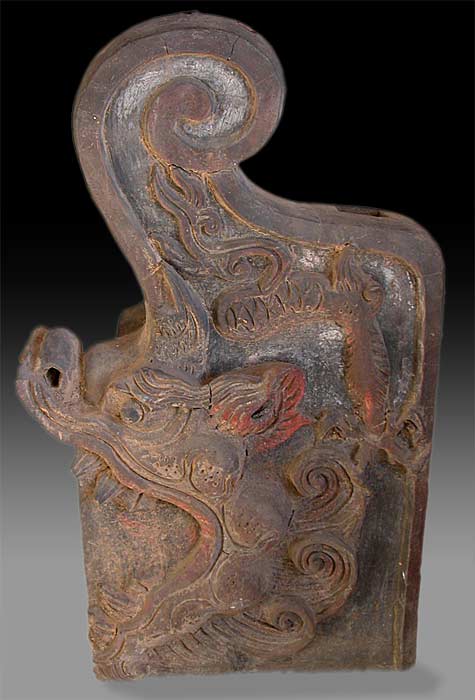
Ming to Early Qing Dynasty, circa: 17-18th century
h.31 in.(79cm.) X w.7.5 in.(19cm.) X d.17.5 in.(44cm.)
Condition: Good, minor chips
This magnificent ceramic dragon corbel is a splendid architectural relic to an ancient Chinese culture-- when cosmology played a significant role in architectural positioning and design. Particularly for the harmony of the surroundings about natural energy flow. As in Fengshui cosmology, five sacred creatures symbolize the four cardinal directions; the snake and tortoise for the north, the white tiger for the west, the red Pheonix for the south, and the dragon for the east.
This large hollow-cored water corbel features an energetic and menacing dragon with a wide-opened mouth, bulging eyes, flaring nostrils, large fangs, and a flaming red tongue. It was a part of the roof structure that functions as a water drainage collection on the east side. Subsequently, its purpose is to produce an auspicious aura that creates a positive cosmic current generating positive Feng Shui. Considering that the dragon is an emblem of Chinese imperial rule, this large hollow brick would have been made for an official building. The absence of glaze on this otherwise well-sculpted piece indicates that the roof tile is a well-preserved rare find from the late Ming to early Qing era.